
The AI craze is in full swing. Week after week, we’re flooded with new information about how artificial intelligence can make our lives better. From work to learning to daily productivity, AI companions are being hailed as next digital assistants.
☑️ The Smart Stuff of AI Companions #
There are a lot of things to cover about AI assistants, especially about large language models. But I want to keep this focused and to the point.
-
Helps you to stay focused and act faster : AI assistants can help in streamlining, understanding research data and gaining deep insights, planning and decision making.
-
Retrieval Augmented Generation : It saves a lot of time by utilizing your past data and providing you with detailed insights, context-aware responses.
-
Increased Productivity : From searching the net to drafting emails, they help you accelerate repetitive tasks.
-
24/7 Availability : Available round the clock. Of course with rate limits as well in case of too many requests.
-
Personalized experiences : Get tailored recommendations, suggestions, and insights based on your preferences.
-
Flexible interaction modes : You can use voice, text to converse, whichever suits your workflow.
-
Helps code faster: Speeds up writing boilerplate, suggesting snippets, and even generating entire modules or projects from scratch.
This article you’re reading was also grammar-checked by an AI assistant.
⚠️ The Watchouts of AI Companions #
But it’s not all smooth sailing. Despite the hype, AI companions have limitations and risks:
-
Lack of self-awareness : AI doesn’t indicate that it’s providing you with uncertain information. Yes, it’s our responsibility to spot inaccuracies.
-
Bias and hallucinations : Sometimes the responses reflect bias or confidently incorrect information.
-
Error-Prone Code : While it can generate code quickly, debugging and fixing errors can take a good amount of time. An added benefit of some programming languages is compile-time error detection, allowing faster and more reliable fixes.
-
Code duplication and rewrites : Expect a lot of reworking or rewriting at every iteration to ensure maintainability and clarity.
-
Quality assurance struggles : Ensuring consistent, production-grade output still requires human skills.
-
Monitoring Tokens Consumption : Continuously monitor token usage to ensure its not going beyond budgets. There are some cases where it abruptly stops the work when the token limit is reached.
-
Hardware Challenges for local Models : Running open-source models locally demands high-end hardware. There are smaller models which can do the work but the output is still not fully satisfactory.
-
Security hygiene & Privacy: Always review generated code, what data is shared and which prompt commands are used to ensure it’s not recommending anything malicious.
-
Uses outdated code: Many models are trained on older data and may suggest outdated libraries or practices. It’s important to mention the coding assistant to check online up-to-date documentation. Some providers do support this.
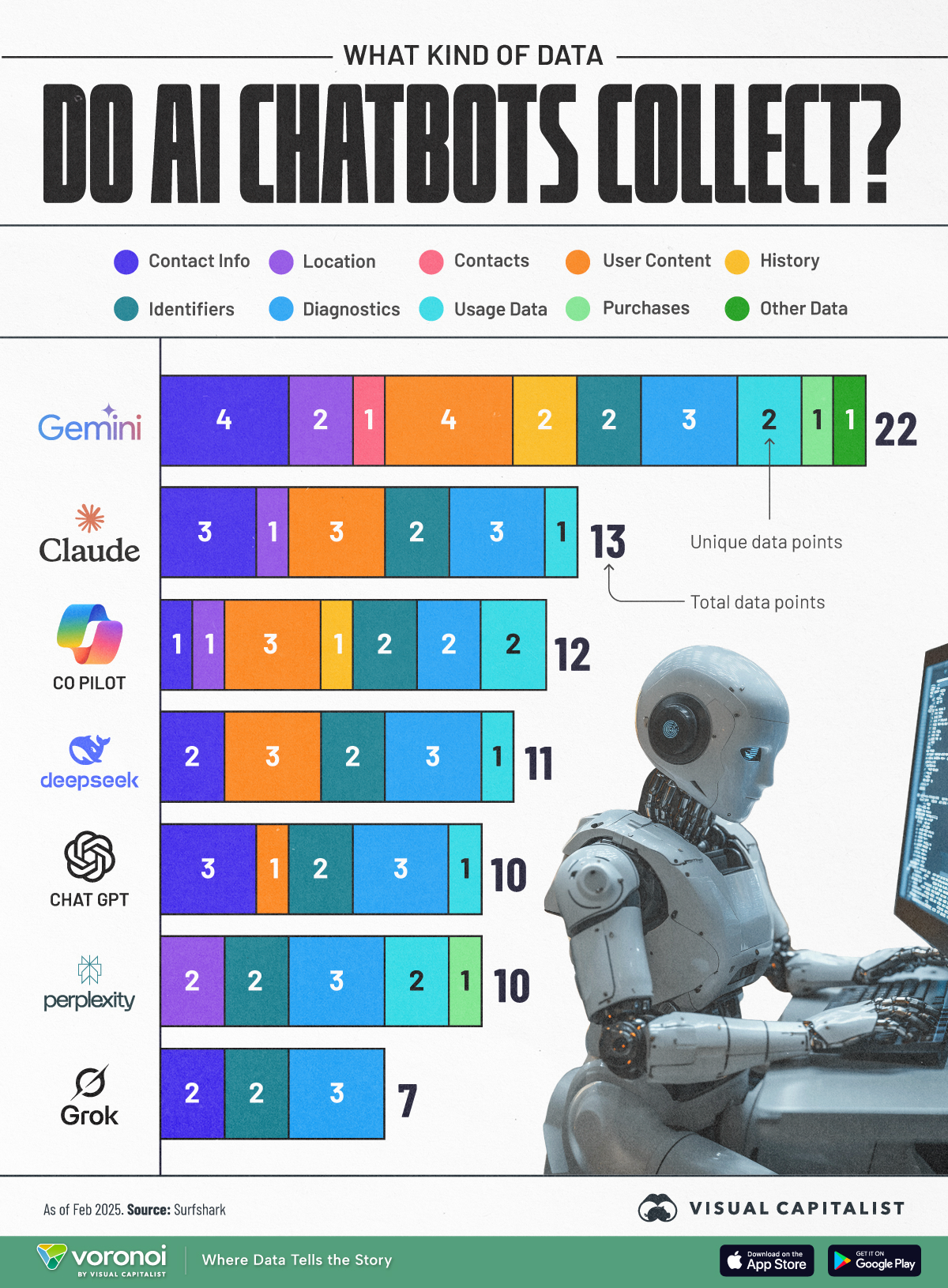
🗂️ Data Collection - Infographic #
The below infographics for the data conscious users.
📜 Summary #
AI coding assistants and conversational AI’s are undeniably powerful tools with the potential to transform how we work, learn, and interact. They are not perfect, but it also comes with its own challenges.
The key is thinking them as an assistant to augment to our own abilities. (like Jarvis in Iron Man’s movie). It is also about using them to boost our productivity without losing our focus. Understanding its capabilities and limitations can help us to make better decisions and being mindful of our data.
Also, it’s hard to say that one AI can get all things done. Experiment, learn and use the one that helps you do your work best.
What are your thoughts? feel free to write back to me.